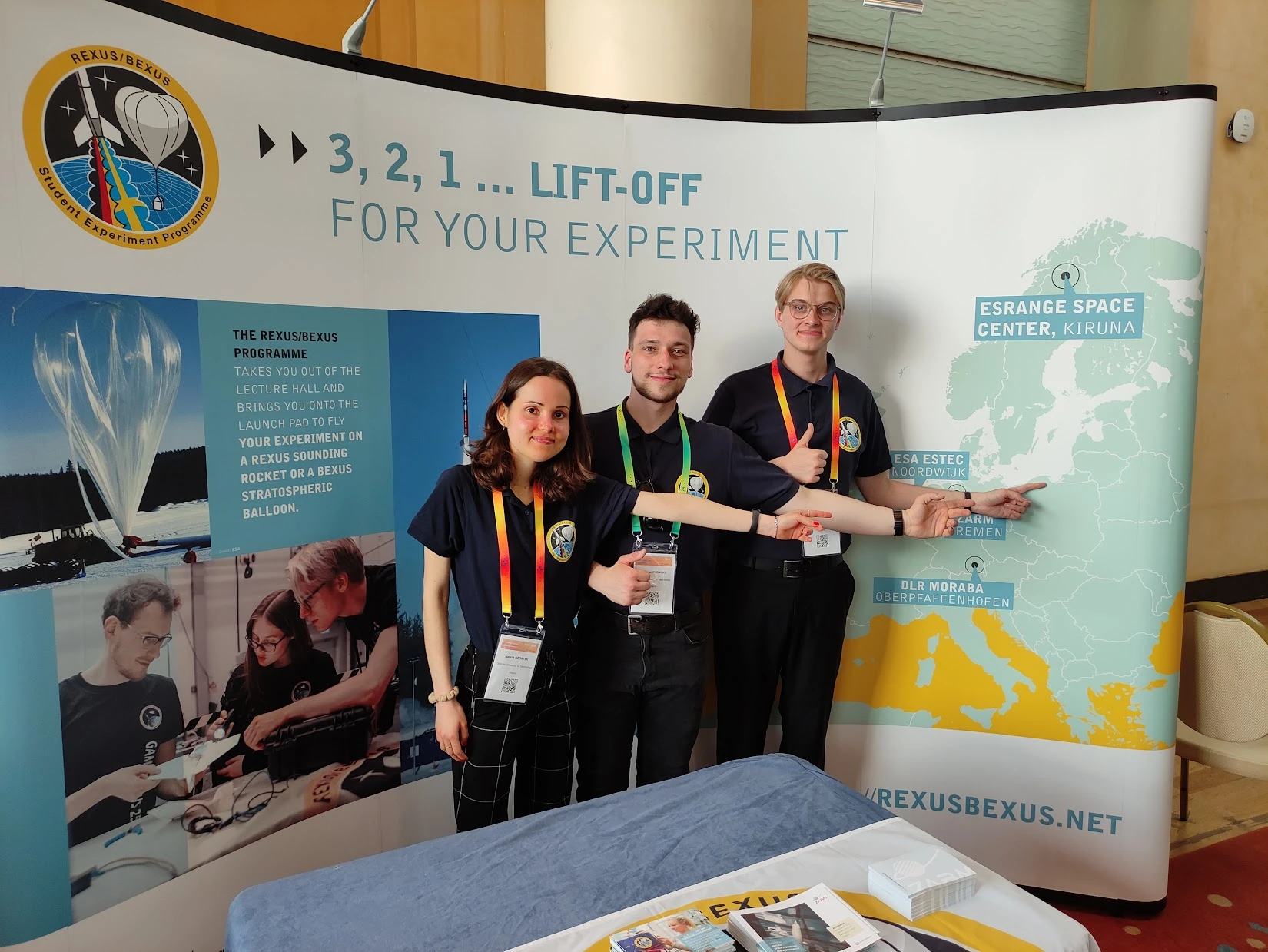
Seven months after the BEXUS 30 flight we had our first results, and the place to show them was the 25th ESA Symposium on European Rocket and Balloon Programmes and Related Research, PAC for short, in Biarritz, France. It's where people who work with sounding rockets and stratospheric balloons in Europe meet, from the agencies to student teams like ours, so it was a good audience for a first look at the data.
Quick reminder of what we flew. The Stardust sampling system had six filters: three for sampling and three controls that stayed sealed between closed valves for the whole flight. After the balloon passed 15 km, the valves opened and two pumps pulled stratospheric air through the filters for 244 minutes. At the same time an identical copy of the experiment, the "groundbox", ran at the launch pad in Esrange, so we could compare the stratosphere with the air near the ground.
Most of the work went into not contaminating anything. Every tube, valve and joint was washed with filtered isopropanol and sterilised in an autoclave, and the system was assembled in a laminar flow cabinet by someone wearing sterile gloves. An hour before liftoff the whole gondola got sprayed with isopropanol, inside and out. With so few microbes up there, one careless touch could ruin the result.
What we found so far:
- The stratosphere is really poor in microorganisms compared to the air we breathe. The flight filters gave us 8 colonies: 7 bacterial strains and 1 mold.
- All of them grew from the samples we kept at 0.1 bar. The stratospheric samples kept at normal pressure gave us nothing.
- None of the stratospheric bacteria were Gram-negative. Gram-positive bacteria have thick cell walls, which may be what protects them up there.
- They took much longer to grow than the ground samples. Our explanation is that they are adapted to the harsh conditions and need time to readjust to the lab.
MALDI-TOF mass spectrometry identified some of them, for example Microbacterium oleivorans and Bacillus licheniformis, but many came back as "unspecified". Part of the reason is that the database we used is made mostly for pathogenic bacteria. Our estimate is that up to 10 new species or strains might be in the samples, either from the stratosphere or from the ground air in northern Sweden. The DNA is prepared for sequencing, but we still need the funding to do it.
The discussions after the presentations were really useful. One question stuck with us: can we be sure that every culture really came from the stratosphere? The balloon surface is not sterile, and the caps on our air inlets come off before launch. It's a fair point, and we will need to answer it.
PS: Thanks to all the friends and members of other teams in the Cycle 13 of REXUS/BEXUS programme! It was a pleasure meeting you, and I hope it is not the last time we meet...
Read the full paper: BEXUS 30 Stardust - Preliminary Results of Investigation of Microbes in the Stratosphere (PDF).